Physics I. – Seminary (E026002) & Practical Class in Physics I (E023013)
Monday 17.00–18.30; Room 306.
HW from Oct 26; to be handed in before the class on Nov 2
-
[0.5%]; From the knowledge of the Earth’s orbital period around the Sun and the Earth’s distance from the Sun (NB 8 minutes), estimate the mass of the Sun. Try to do all the numerics manually (not using a calculator; make estimations). You will probably need the gravitational constant \$G\approx 7\times10^-11 "N" "kg"^-2 "m"^2\$.
-
[0.5%]; Calculate the tension \$T\$ in the chain DC, which connects two arms (AE and BE) of a double-sided ladder:
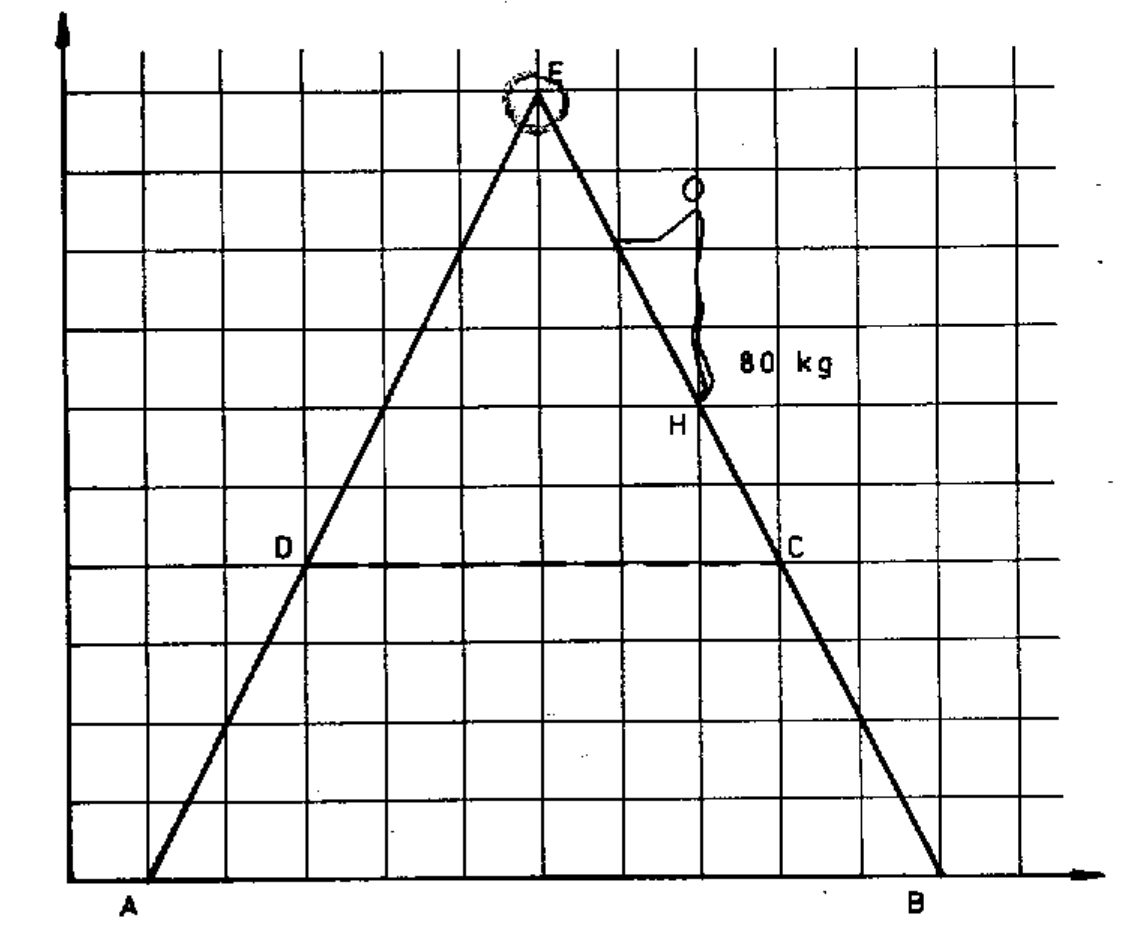
The floor is absolutely smooth, the mass of the person is given (80 kg), the ladder (all its parts) is considered massless, and there is no friction in the hinge E.
-
[0.5%]; A massless rod with three (point-like) weights attached to it is released from the horizontal position. What will be its angular velocity at the lowest position? What will the speeds of the three weights be there? There is no friction in the hinge. The unit of length along the axes in the figure is 1 meter.
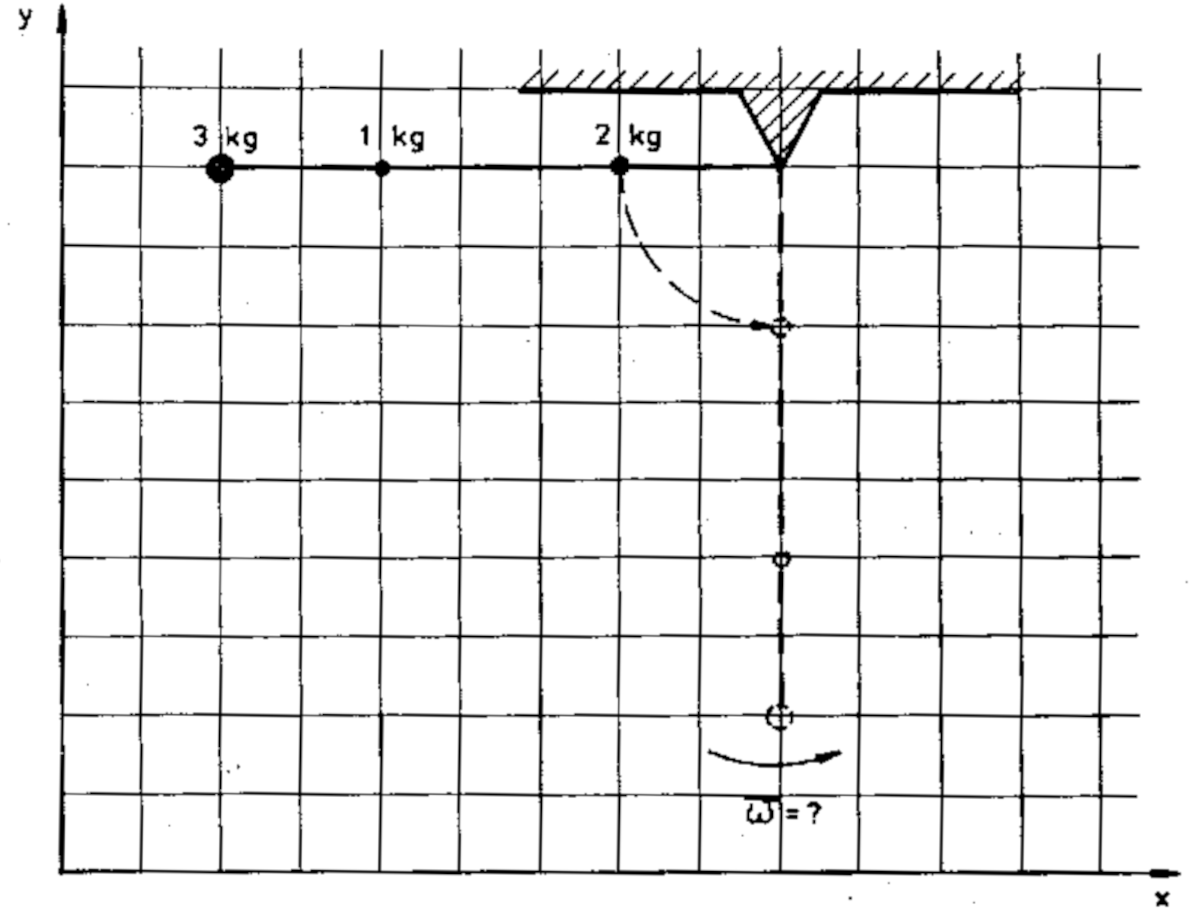
-
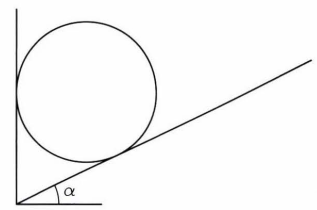
[0.2%]; A ball of radius 3.0 cm and weight 1.0 kg rests on a plane tilted at an angle \$\alpha=30°\$ with the horizontal and also touches a vertical wall, as shown in the figure below. Both surfaces have negligible friction. Find the force with which the ball presses on the wall \$F_w\$ and on the plane \$F_p\$.
-
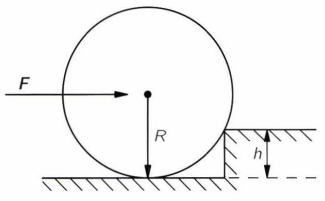
[0.2%]; What horizontal force \$F\$, applied at the axle, is required to push a wheel of weight \$W\$ and radius \$R\$ over a block of height \$h\$, as shown in the figure:
HW from Oct 19; to be handed in before the class on Oct 26
-
[0.3%]; How would the answer to Problem 16 change if the given angle was 10° (instead of 50°)?
-
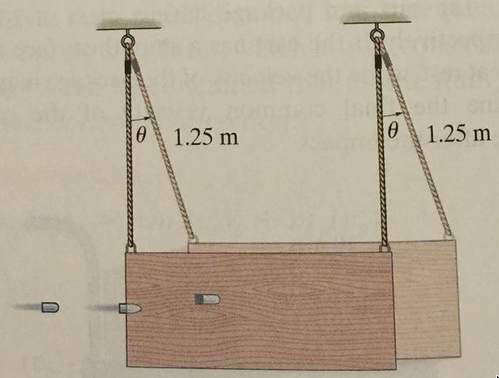
[0.5%]; A ballistic pendulum, see below, consists of a 4-kg wooden block originally at rest, \$\theta=0^\circ\$. When a 2g bullet strikes and becomes embedded in it, it is observed that the block swings upward to a maximum angle of \$\theta=6^\circ\$. Estimate the initial speed of the bullet. The length of each rope is 1.25 m.
-
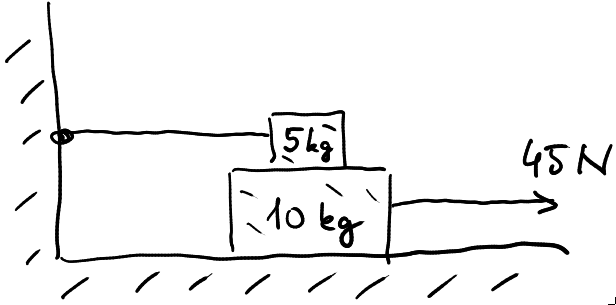
[0.3%]; A block of mass 5 kg lies atop another of mass 10 kg. The former is firmly attached to the wall. The latter is acted upon with a force of 45 N, as displayed below, and moves. What is its acceleration if the coefficient of dynamic friction acting between all the surfaces is 0.2? (Take \$g=10" m/s"^2\$.)
-
[0.7%]; Using the law of universal gravitation, \$F_g = G {m_1 m_2} /r^2\$, and knowing the radius of the Earth and the gravitational acceleration at Earth’s surface, determine the altitude above Earth’s surface required for a satellite to remain geostationary. Do all the numerics manually (not using a calculator; make estimations). Can you use the same procedure to estimate the Earth-to-Moon distance? Compare the latter to the satellite altitude. (Apart from what was mentioned above, you are supposed to know how long a day and a month are; ie, nothing more.)
-
[0.3%]; What is the instantaneous power of the force \$\vec{F}\$ in the figure below, acting on a massive point moving with velocity \$\vec{v_0}\$? What will the movement of the point be like if the acting force stays constant? Write down how the position will develop in time, \$\vec{r}(t)\$.
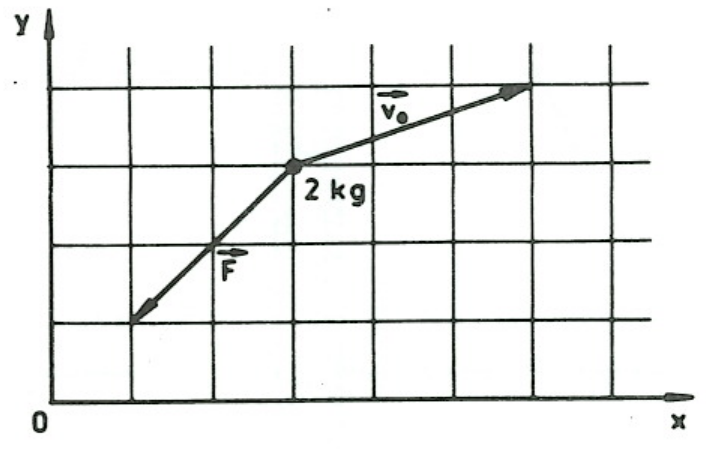
The units of length and speeds in the figure are 1 meter and 1 meter per second, respectively.
-
[0.7%]; Think about an object (e.g., the Moon) orbiting the Earth, following a circular orbit with radius \$R\$. Try to think about its motion as if being composed of two effects: (i) tendency to fly away along the instantaneous tangent (\$h\$) and (ii) falling towards the centre (\$\Delta\$):
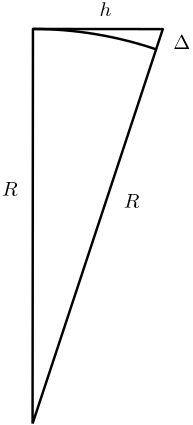
First, show from the geometry alone that for small \$h\$ it holds \$\Delta\approx h^2/{2R}\$. Second, imagine the figure depicts the development through a short time span \$t\$ and show that \$R=v^2/g\$ (once again!) where \$v\$ is the speed of the object and \$g\$ is the normal acceleration of the object (due to gravity in the case of the Moon).
HW from Oct 12; to be handed in before the class on Oct 19
-
[0.3%]; "The Archer, the Squirrel, and the Nut": The archer wants to hit a nut that a squirrel on a tree has in its teeth. They agree that at a specific time the archer will shoot and the squirrel will drop the nut at the same moment. Where should the archer aim when shooting to hit the nut?
-
[0.5%]; Think about the problem 10 again and solve it by drawing a graph of the objects' speeds in time and answering the questions: Where is the moment when the objects meet? At that moment, what are the speeds of the objects? What is the relation between the time of the whole process, the initial speed (of the lower object), and \$g\$? What is the average speed of the top / bottom object throughout the whole process? Eventually, recall that if we know an average speed, the travelled distance is simply related to the process time…
-
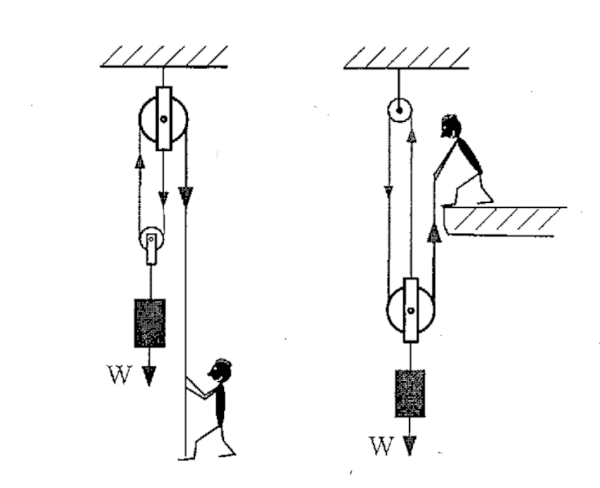
[0.5%]; In the figure below, assume that all the pulleys and the rope are massless, and that the pulleys rotate without friction. The system is at rest. Determine the pulling force required from the human.
-
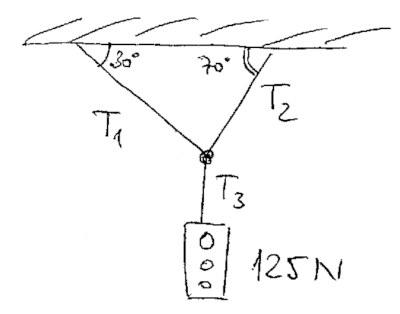
[0.4%]; Determine the tensions T1, T2, and T3 in the ropes shown below. The traffic light weighs 125 N.
-
[0.7%]; We shoot a projectile horizontally (in the Earth’s gravitational field). What is the radius of curvature of its trajectory just after it has left the gun? If the initial speed is \$v_0\$ and the shooting happens at a height \$h\$ above the Earth’s surface, under what angle will the projectile hit the ground and what will be the trajectory curvature at that moment?
-
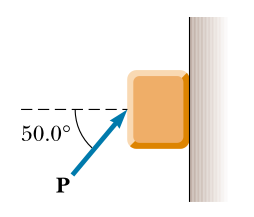
[0.7%]; A block of mass 3.00 kg is pushed up against a wall by a force \$P\$ that makes a 50.0° angle with the horizontal as shown in the figure below. The coefficient of static friction between the block and the wall is 0.25. Determine the possible values for the magnitude of \$P\$ that allow the block to remain stationary.
HW from Oct 5; to be handed in before the class on Oct 12
-
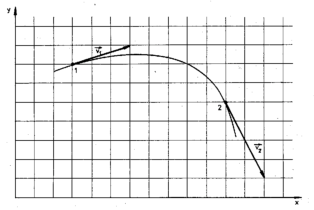
[0.2%]; In a two-dimensional movement depicted in the figure below, an object gets from point 1 to point 2 in 2 seconds. Its velocities at the two points are given in the figure. The unit of length along the axes is 1 meter for positions and 1 meter per second for velocities. Calculate the average velocity and the average acceleration for the period between the two points.
-
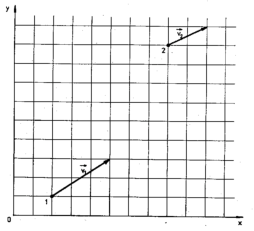
[0.3%]; Two points depicted in the figure below at time t=0 move with constant velocities given by the figure. Decide if the points will meet or not. The unit of length along the axes is 1 meter for positions and 1 meter per second for velocities.
-
[0.3%]; With the knowledge that \$ln(1+x) approx x\$ for small \$x\$ (more precisely: for small \$x\$ it holds that \$ln(1+x) = x + o(x)\$ where \$lim_{x -> 0} {o(x)} / x = 0\$) prove that the derivative of \$ln(x)\$ is \$1/x\$.
-
[0.5%]; ladders: 2 ladders put between 2 walls of heights \$h_1\$ and \$h_2\$, first ladder going from the heel of the first wall to the top of the second wall, the other ladder vice versa. At what height do they meet?
-
[0.5%]; A runner runs a race consisting of two laps. The first lap is run with an average speed of 10 km/h. What would his average speed in the second lap have to be so that his average speed in the whole race equals 20 km/h?
-
[0.7%]; There are two objects in a uniform gravitational field (represented by \$g\$), held at rest one above the other, separated by a distance \$h\$. The upper object is released and starts to fall. What (upward) speed has to be imparted instantaneously to the lower object, so that they meet exactly midway? Draw a figure showing the speed of both objects over time, and mark the moment when they meet; what is the speed of the lower object at that moment? What is the relation between the average speeds of the two objects over the process?!
There is no class on Sep 28
We will meet again on Oct 5.
HW from Sep 21; to be handed in just before the class on Oct 5
-
[0.3%]; For a regular pentagon, what is the sum of vectors (five of them) going from its centre to the vertices? Give the simplest argument you can find to support the value.
-
[1%]; Using the result of the previous problem, find the algebraic expression for \$\cos 72°\$ by manipulating the expression \$\vec{e_1}\cdot(\vec{e_1} + \vec{e_2} + \vec{e_3} + \vec{e_4} + \vec{e_5})\$, where \$\vec{e_1},...,\vec{e_5}\$ are the individual vectors going from the pentagon centre to the vertices.
Hint
NB. Take \$\vec{e_i}\$ (where \$i=1, ..., 5\$) to be of unit magnitude. NB. \$\vec{a}^2=\vec{a}\cdot\vec{a}\$. There are actually only two types of scalar products in the expression: those of directly neighbouring vectors (such as \$\vec{e_1}\cdot\vec{e_2}\$), and those of having one other vector in between (eg, \$\vec{e_1}\cdot\vec{e_3}\$). The value of the former type is \$x≡\cos 72°\$, while the value of the latter is \$\cos (2 \times 72°)\$. NB. \$\cos(2φ)=\cos^2(φ) - sin^2(φ) = 2\cos^2(φ) - 1\$. In this way you get a quadratic equation for \$x\$, which you solve.
-
[0.3%]; Show that the derivative of \$\sin x\$ w.r.t. \$x\$ is \$\cos x\$. You can take for granted (but check it on your calculator with a small number close to 0 and show it to me!) that \$\lim_{x→0} \sin x / x = 1\$ and \$\lim_{x→0} (1 - cos x) / x = 0\$.
-
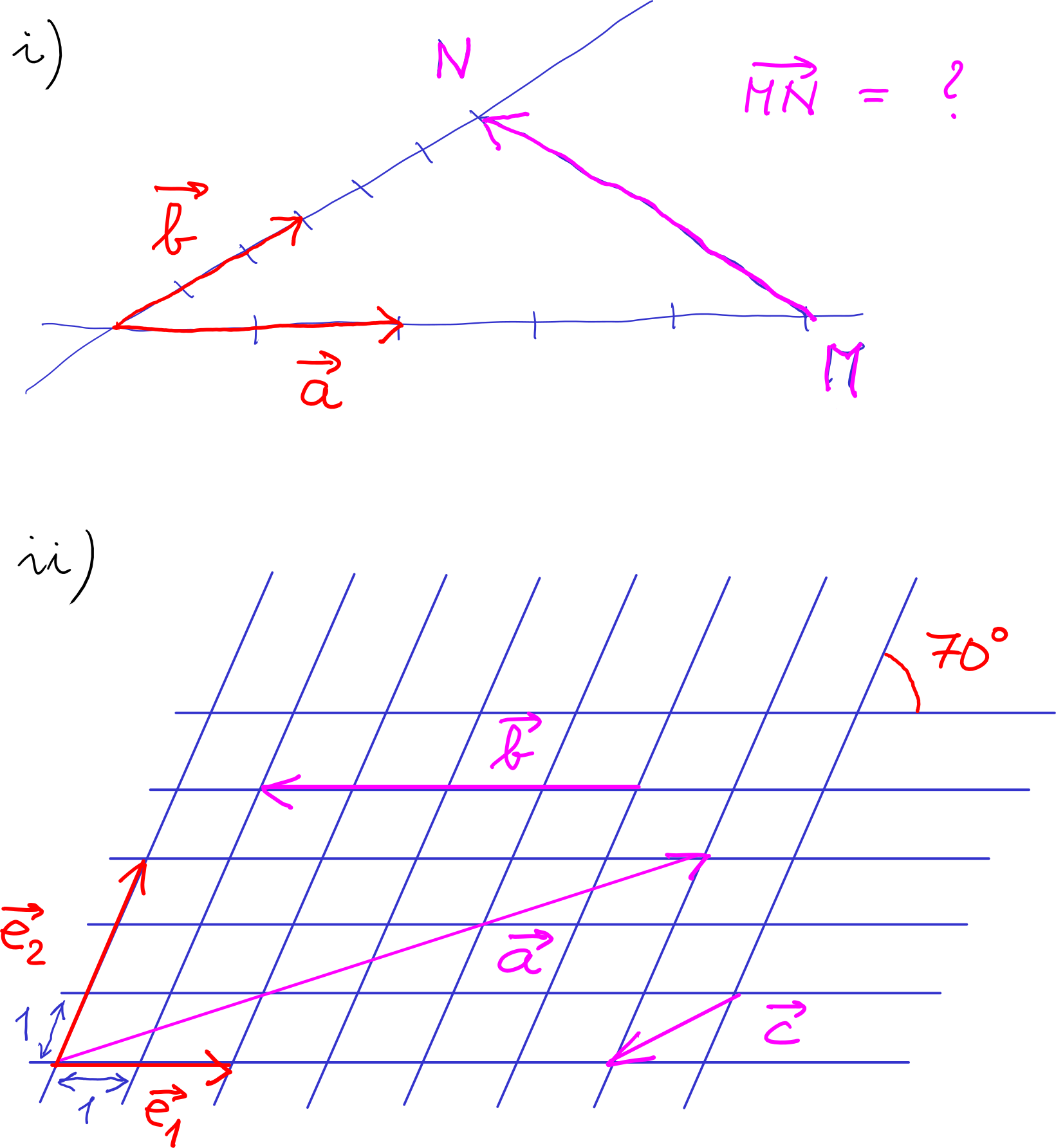
[0.4%]; For i) below find the expression for the vector \$\vec{MN}\$ in terms of the shown basis vectors \$\vec{a}\$ and \$\vec{b}\$. For ii) find the expressions for the vectors \$\vec{a}\$, \$\vec{b}\$ and \$\vec{c}\$ in terms of the basis \$\vec{e_1}\$ and \$\vec{e_2}\$, and try to calculate the angle between vector \$\vec{a}\$ and \$\vec{c}\$. For the latter, note the distances drawn in blue.
Homework assessment as of Oct 19
| who | points | Σ max of attempted with >0 assessment | Σ obtained points |
|---|---|---|---|
anchor |
5(0), 6(0.3), 8(0.1), 9(0.5), 10(0.5), 11(0.3), 12(0.1), 13(0.2), 14(0.4), 15(0.4), 16(0.7) |
5.3 |
3.5 |
anvil |
1(0.2), 2(0.6), 3(0.2), 4(0.1) |
2.0 |
1.1 |
bag |
0.0 |
0.0 |
|
basil |
1(0.2), 2(1.0), 3(0.2), 4(0.4), 5(0.2), 6(0.1), 7(0.3), 8(0.5), 9(0.5), 10(0.7), 11(0.1), 13(0.2), 14(0.4), 16(0.7) |
6.4 |
5.5 |
bear |
1(0.1), 2(1.0), 3(0.2), 4(0.1) |
2.0 |
1.4 |
bed |
1(0.1), 2(1.0), 3(0.1), 4(0.1), 5(0.2), 6(0.3), 7(0.3), 8(0.5), 9(0.5), 10(0.5), 11(0.3), 12(0.2), 13(0.2), 14(0.4), 15(0.7), 16(0.7) |
7.6 |
6.1 |
bird |
1(0.1), 2(1.0), 3(0.2), 4(0.1), 5(0.1), 6(0.15), 7(0.15), 8(0.25), 9(0.25), 11(0.3), 12(0.1), 13(0.5), 14(0.4), 15(0.7), 16(0) |
6.9 |
4.3 |
blanket |
1(0.3), 2(1.0), 3(0.2), 4(0.2), 5(0), 6(0), 8(0.5), 9(0.5), 11(0.3), 12(0.1), 13(0.1), 14(0.4), 16(0.7) |
5.9 |
4.3 |
brick |
1(0.1), 2(1.0), 3(0.2), 4(0.4), 5(0.1), 6(0.3), 7(0.3), 8(0.5), 9(0.5), 10(0.6), 11(0.3), 13(0.5), 14(0.4), 15(0.2), 16(0.2) |
7.1 |
5.6 |
bridge |
1(0.2), 2(1.0), 3(0.2), 4(0.4), 5(0.2), 6(0.3), 7(0.3), 8(0.5), 9(0.5), 11(0.3), 12(0.3), 13(0.5), 14(0.4), 15(0.7), 16(0.6) |
6.9 |
6.4 |
button |
1(0.3), 2(1.0), 3(0.3), 4(0.3), 5(0.2), 6(0.3), 8(0.5), 9(0.5) |
3.5 |
3.4 |
candle |
0.0 |
0.0 |
|
cat |
1(0.1), 2(1.0), 3(0.2), 4(0.1), 5(0.2), 6(0.3), 7(0.3), 8(0.5), 9(0.5), 10(0.7), 11(0.3), 12(0.1), 13(0.2), 14(0.4), 15(0.7), 16(0.7) |
7.6 |
6.3 |
chair |
0.0 |
0.0 |
|
clock |
1(0.3), 2(1.0), 3(0.3), 4(0.2), 5(0.2), 6(0.3), 7(0.3), 8(0.5), 9(0.5), 10(0.7) |
4.5 |
4.3 |
dog |
1(0.1), 2(1.0), 3(0.3), 4(0.4), 5(0.2), 6(0.3), 7(0.3), 8(0.5), 9(0.5), 10(0.7), 11(0.3), 12(0.2), 13(0.2), 14(0.2), 15(0.7), 16(0.7) |
7.6 |
6.6 |
flower |
1(0.1), 2(1.0), 3(0.2), 4(0.1), 5(0.2), 6(0.3), 7(0.2), 8(0), 9(0.5), 10(0.2), 11(0.2), 12(0), 13(0.2), 14(0.4), 15(0.7), 16(0.7) |
7.6 |
5.0 |
fox |
5(0.2), 6(0.3), 7(0.3), 8(0.5), 9(0.5), 11(0.3), 12(0.5), 13(0.5), 14(0.2), 15(0.7), 16(0.7) |
4.9 |
4.7 |
harbor |
5(0.1), 6(0.3), 9(0.5), 10(0.5), 11(0.3), 13(0.2), 14(0.4), 15(0.4), 16(0.2) |
4.3 |
2.9 |
job |
1(0.1), 2(1.0), 3(0.3), 4(0.2), 5(0.2), 6(0.3), 7(0.3), 8(0.5), 9(0.5), 10(0.7), 11(0.3), 12(0.1), 13(0.5), 14(0.4), 15(0.4), 16(0.7) |
7.6 |
6.5 |
ladder |
0.0 |
0.0 |
|
lamp |
1(0.2), 2(1.0), 3(0.2), 4(0.4), 5(0.2), 6(0.3), 7(0.3), 8(0.5), 9(0.1), 11(0.3), 13(0.5), 14(0.4), 15(0.7), 16(0.7) |
6.4 |
5.8 |
lantern |
5(0.2), 6(0.3), 7(0.3), 9(0.1) |
1.3 |
0.9 |
mirror |
1(0.3), 2(1.0), 3(0.3), 4(0.3), 5(0.2), 6(0.3), 7(0.3), 8(0.5), 9(0.1), 10(0.7), 11(0.3), 12(0.2), 13(0.5), 14(0.4), 15(0.7), 16(0.7) |
7.6 |
6.8 |
pen |
1(0.3), 2(1.0), 3(0.2), 4(0.2), 5(0), 6(0.2), 7(0.2), 8(0.5), 9(0.5), 10(0.5), 11(0), 12(0.1), 13(0.4), 14(0.4), 15(0.6), 16(0.6) |
7.6 |
5.7 |
1(0.1), 2(0.0), 3(0.2), 4(0.4), 5(0.1), 6(0.2), 7(0.3), 8(0), 9(0.5), 10(0.5), 11(0.3), 12(0.1), 13(0.5), 14(0.4), 15(0.7), 16(0.7) |
7.6 |
5.0 |
|
river |
0.0 |
0.0 |
|
table |
0.0 |
0.0 |
|
teacher |
1(0.1), 2(1.0), 3(0.2), 4(0.1), 5(0.2), 6(0.3), 7(0.3), 8(0.5), 9(0.5), 10(0.7), 11(0.2), 12(0.1), 13(0.2), 14(0.4), 15(0.7) |
6.9 |
5.5 |
toast |
1(0.1), 2(1.0), 3(0.2), 4(0.4), 5(0), 6(0.3), 7(0.3), 8(0.5), 9(0.5), 10(0.7), 11(0.3), 12(0.2), 13(0.5), 14(0.4), 15(0.7), 16(0.7) |
7.6 |
6.8 |
window |
0.0 |
0.0 |
|
wire |
1(0.1), 4(0.1), 13(0.5), 14(0.2), 16(0.7) |
2.3 |
1.6 |
Maximum points per problem
HW # |
max |
1 |
0.3 |
2 |
1.0 |
3 |
0.3 |
4 |
0.4 |
5 |
0.2 |
6 |
0.3 |
7 |
0.3 |
8 |
0.5 |
9 |
0.5 |
10 |
0.7 |
11 |
0.3 |
12 |
0.5 |
13 |
0.5 |
14 |
0.4 |
15 |
0.7 |
16 |
0.7 |
17 |
0.3 |
18 |
0.5 |
19 |
0.3 |
20 |
0.7 |
21 |
0.3 |
22 |
0.7 |
Requirements for awarding credits
mod Oct 4: “on paper” metioned explicitly; “before the beginning” changed to “at the beginning”
mod Oct 20: stress that delayed HW submission is disregarded; mention that excusing from a lesson is not needed
mod Oct 27: PDF format for the scan; name on each solution
-
During the course, I assign homework on a weekly basis. I require (!! failure to do so will automatically mean you will not receive the credits) you hand in a handwritten solution on paper to problems worth at least a 10% value: each assignment has an accompanying percentage value, and the sum of these is the relevant number, with an extra condition that your solution gets a non-zero score (solutions with pure-zero scores are completely disregarded). The 10% sum has to be reached by December 7 at the latest. Each solution is to be handed at the beginning of the class following the homework assignment (any later submission will be disregarded). Only if you know you will not be present, send its scan in the PDF format by email before the same deadline. Make sure there is your name / nickname (which I provide to each one of you) on your solution. Furthermore, write carefully and clearly; if I cannot read your writing, I will not consider it at all.
Homework assignments will be put on this page shortly after each class.
Each solution will lower the 60% threshold mentioned below by an amount up to the assignment percentage value, depending on the correctness of your solution. The maximum total decrease is, however, limited to 15%.
-
Towards the end of the semester (most probably on December 7) you will be asked to solve a set of problems during class. If you get > 60% of the points (but read above about lowering this number), you get the credits. If not, we will first discuss correct solutions and the difficulties you faced (in the group as well as individually), most probably on December 14. You will then have one more opportunity to solve another set of problems in class; this will likely be in the last lesson of the semester on January 4, and under the same conditions. If not successful, we will still try to work on the individual level (during the exam period) but this will only be available to people whose class attendance was > 75% (make sure you write your name down on the attendance sheet at the end of each lesson; note that you do not have to excuse yourself from any lesson you do not attend).
Remember, it is important that you interact during class so that I get a feeling for what you know as well as do not know. And I especially appreciate if I see you working out (or at least trying to work out) the homework assignments. If you happen to be close to the threshold and I remember you regularly tried to solve / discussed the problems, you may still pass.
The requirements above may still be subject to minor modifications.